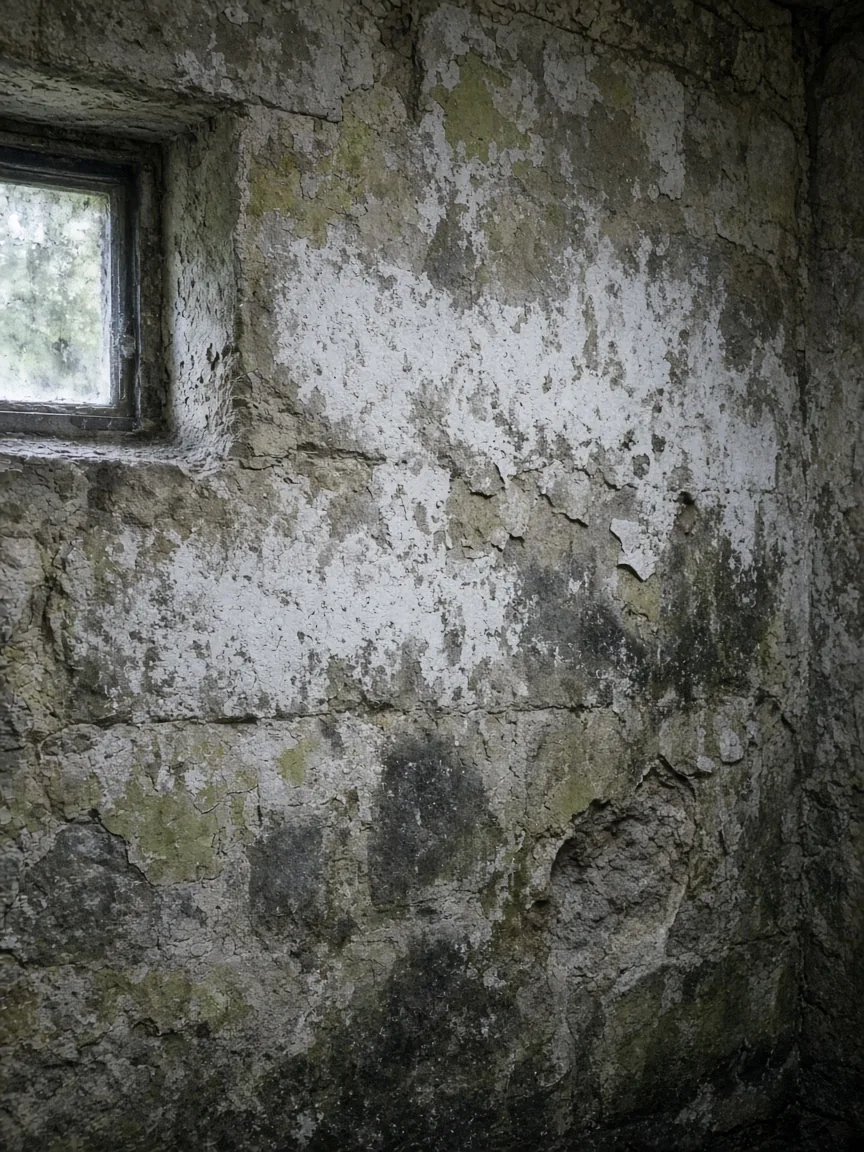
Moisture gets through a stone foundation in Kansas City by three routes: roof and surface water soaking the soil against the wall, ground moisture wicking up through stone and mortar, and humid summer air condensing on cool stone, and each has a different fix.
A damp stone wall is not one problem. Treating condensation like a leak wastes money, and sealing a leaking wall shut makes it worse. The method on this page follows the National Park Service's guidance on moisture in old buildings, Preservation Brief 39.
Seepage or condensation: a simple foil test
Before anyone spends money, find out which way the water is moving. Preservation Brief 39 describes a foil test: tape a square of aluminum foil tightly to the stone and leave it for a day or two. If moisture collects behind the foil, against the stone, the wall itself is wet. If moisture collects on the room side of the foil, it is condensation from the air.
Timing helps too. Dampness that appears during or soon after rain, and follows the joint lines or the base of the wall, points to water coming from outside. Dampness that shows up on humid summer days, even when it has not rained, points to condensation.
The brief also notes that diagnosis can take months, up to four seasons. A wall that looks dry in January may tell a different story in May.
White crust and tide lines on the stone
A white, powdery or crusty deposit on the stone is efflorescence. Preservation Brief 39 describes it as a whitish stain or tide line, often 1 to 3 feet above grade, left where moisture evaporates and leaves its salts behind. Efflorescence is a symptom, not damage in itself. It tells you water is moving through the wall and drying out at that height. Over time, salts crystallizing in the stone can break up its surface, so a heavy, recurring tide line is worth acting on.
Start outside: gutters, downspouts and grade
Preservation Brief 39 puts the order of work for ground moisture plainly: slope the grade away from the foundation, carry downspout water well away, and add surface drainage where there is none. Excavation, coatings and footing drains come later, if at all.
- Downspouts. The brief notes that a rain of 2 inches in an hour can send about 200 gallons through one downspout in that hour. A downspout that empties at the foundation soaks the soil against the wall below it.
- Gutters. The brief recommends cleaning gutters at least twice a year. A clogged gutter spills along the whole wall.
- Grade. The brief's target is roughly 6 inches of fall in the first 10 feet away from the foundation.
Local soil makes this matter more. K-State Research and Extension in Johnson County describes area soils as very high in clay, and clay that has soaked up water holds it against the wall. The same clay swells when wet and can push the wall, which is why a damp wall and a bowing wall can turn up on the same side of a house. A short note on window wells: a well that collects water against a stone wall is part of the same problem and should drain or be covered.
Why waterproof paint and cement coatings backfire on stone
It seems logical to seal a damp wall from the inside. Preservation Brief 39 explains why that goes wrong on old masonry: waterproof coatings on the inside of a damp wall, such as cement parging or vinyl coverings, can trap moisture and drive rising damp higher up the wall. The water does not stop. It finds a new place to evaporate, often higher up or behind the coating, where it does more damage.
Breathable finishes that suit a stone wall
Where a stone wall needs a protective or sacrificial coat, Preservation Brief 39 recommends a vapor permeable, lime-based render. A lime coat lets moisture escape, takes the wear instead of the stone, and can be renewed. It is the right choice when a wall's surface is badly eroded or when you want a finished look without trapping water.
Repointing as a moisture repair
Open joints let water straight into the wall. Once the outside water is under control, refilling eroded joints with a breathable lime mortar closes those paths while still letting the wall dry. Our pages on lime mortar repointing and limestone foundation repair explain the work.
Interior drains and sump pumps: when they are the right next step
Preservation Brief 39 treats interior perimeter drains and a sump pump as measures for cases where the outside work is not enough. They collect water that has already reached the basement and pump it out. They do not stop water from entering the wall. If you do install a sump pump, the brief notes it needs backup power in storms, when you need it most.
Running a dehumidifier in a stone basement
A dehumidifier is useful for the air, not the wall. The EPA's guide to mold and moisture recommends keeping indoor relative humidity below 60 percent, ideally 30 to 50 percent, and notes that cleaning mold without fixing the water source lets it return. Preservation Brief 39 says a dehumidifier can help with seasonal humidity but should not be used to pull moisture out of walls, and should not run at the same time as a ventilating fan. Use it to manage summer air, and fix the water at its source.
Stone foundation moisture questions
How do you seal a stone basement wall?
You do not seal it shut. A stone wall stays healthy by drying out. Manage the water outside, refill open joints with breathable mortar, and use a lime render if the surface needs a coat. Waterproof coatings on the inside can trap moisture, per Preservation Brief 39.
My stone foundation wall is leaking. What should I do first?
During the next rain, go outside and look at the gutters, downspouts and grade on that side of the house. Photograph where water appears on the inside of the wall and when. Then send us the photos for a look.
Is a damp stone basement normal?
Old stone basements were not built as dry finished space, and some dampness in humid weather is expected. Persistent wetness, recurring tide lines, and joints that keep washing out are the signs to act on.
Will a dehumidifier fix it?
It will manage the air, not the source. A dehumidifier can keep humidity in the range the EPA recommends, but water coming through the wall has to be stopped outside. For what each fix costs, see stone foundation repair cost.
Sources
- National Park Service, Preservation Brief 39: Controlling Unwanted Moisture in Historic Buildings (1996)
- K-State Research and Extension, Johnson County, Clay Soil: It shrinks and swells
- U.S. Environmental Protection Agency, A Brief Guide to Mold, Moisture and Your Home
Get a damp stone wall looked at
Send photos of the damp areas, any white crust, and the downspouts and grade on that side. Ask for a stone foundation moisture quote.