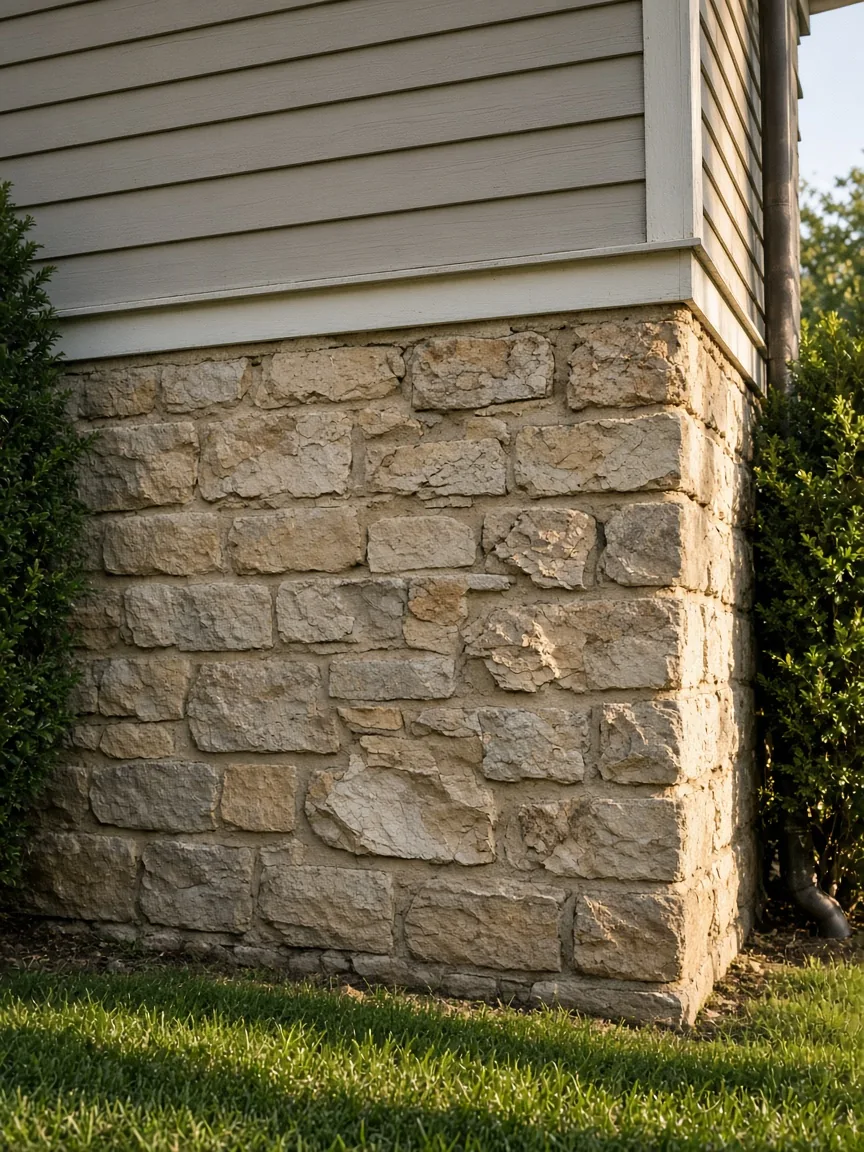
Limestone foundation repair in Kansas City means replacing eroded mortar with a softer lime-based mix, resetting or replacing stone that has loosened or split, and stopping the water that caused the damage.
Limestone is a good foundation stone when it is cared for the right way, and a fragile one when it is patched the wrong way. Two things do the most harm to a limestone wall: water that has been allowed to soak the wall for years, and earlier repairs made with mortar or coatings that were too hard and too tight for the stone. This page explains how limestone foundations fail and how we repair them.
Why Kansas City has limestone foundations
Limestone is the local rock. The Kansas Geological Survey's report on Johnson County geohydrology describes limestones of the Kansas City Group cropping out across the area, and notes that the upper part of the Westerville Limestone, which quarrymen called "Kansas City oolite," has been used as building stone in this area.
Builders used what was close at hand. The National Register nomination for the Old Hyde Park West Historic District, a Midtown neighborhood about three miles south of downtown, lists limestone as the foundation material for its houses and describes limestone retaining walls one to five feet high along its streets.
Cut limestone walls and rubble limestone walls
Limestone foundations come in two broad kinds. A cut or dressed limestone wall is built from squared blocks laid in fairly even courses, with joints of consistent width. A rubble limestone wall is built from rough, irregular pieces laid in a thicker bed of mortar, with joints that vary from narrow to several inches wide.
The repair principles are the same for both, but the work is different. Cut stone walls are mostly about joint repair and replacing individual damaged blocks. Rubble walls are more about resetting loose pieces and deep-pointing wide joints. If your wall is the rough kind, our page on fieldstone and rubble foundation repair goes further.
How limestone foundations fail
Mortar loss. Joints erode first, especially low on the wall and wherever water runs. You see grit on the floor and joints recessed behind the stone face.
Flaking or spalling faces. When joints have been patched with a hard portland cement mortar, the stone around them can start to crack and shed its face. The National Park Service's Preservation Brief 2 explains why: a mortar that is too strong pushes stress into the masonry, which shows up as cracking and spalling, and a mortar that is less permeable traps moisture in the stone.
Salt deposits and tide lines. The Park Service's moisture guidance, Preservation Brief 39, describes efflorescence as a whitish stain or tide line, often 1 to 3 feet above grade, where moisture evaporates and leaves salts behind. The same brief notes that chloride ice melters can make spalling worse, which matters for stone exposed near steps, walks and driveways.
Clay pressure. K-State Research and Extension in Johnson County describes local soils as very high in clay that swells when wet and shrinks when dry, with enough force to crack foundations and basement walls. On a limestone wall that pressure shows up as joints opening, stones shifting, and in worse cases a wall that starts to lean.
How we repair a limestone wall, in order
- Find the water. We look at gutters, downspouts, grade and any window wells on the side that is failing, and we look for the pattern of damp on the wall. If the source is still active, it goes on the quote first. Our page on moisture in stone foundations covers this step.
- Rake failed joints by hand. Loose and soft mortar comes out to sound material. Hand tools are slower than grinders but far kinder to the stone edges.
- Repoint with lime mortar. New mortar is matched to the original and kept softer than the stone. The repointing page explains the method step by step.
- Reset loose stone. Stones that have shifted are taken out, cleaned and bedded again in fresh mortar.
- Replace stone that cannot be saved. Where a block has split through or lost most of its face, we replace it with stone of a similar character.
- Finish with a breathable coat only where it is needed. Where a wall needs a sacrificial surface, Preservation Brief 39 recommends a vapor permeable, lime-based render rather than a cement coating.
Repairs we will not make to limestone
We will not skim a limestone wall with hard portland cement or seal the inside face with waterproof paint. Both feel like progress on the day they go on. Preservation Brief 39 explains that waterproof coatings on the inside of a damp wall can trap moisture and drive rising damp higher, and Preservation Brief 2 explains what hard mortar does to softer stone. The damage shows up a few years later as flaking stone behind a coating that has started to bubble and peel. Our guide on lime mortar vs Portland cement covers the reasoning in full.
When a limestone wall needs more than masonry
If a limestone wall leans, bellies or has stones pushed out of line, repointing alone will not hold it. We measure the wall over time to find out whether it is still moving, and then decide whether it can be repointed, needs a section rebuilt, or needs bracing first. Our page on bowing limestone basement walls explains that decision. For what drives the price of each kind of work, see stone foundation repair cost.
Limestone foundation questions
How long does repointed limestone last?
Preservation Brief 2 says a good repointing job should last at least 30 years and preferably 50 to 100 years. How long yours lasts depends heavily on whether the water problem behind the wall was fixed.
Is flaking limestone a structural problem?
Not always. Surface flaking on a stone face is a durability problem: the stone is losing material, from trapped moisture or salts. A structural problem is a stone that has lost its bearing, split through, or shifted out of line. We check by sounding the stone, looking at whether it has moved, and looking at the joints around it.
Can you match the original stone and mortar?
Usually closely. Preservation Brief 2 says matching starts with analyzing unweathered original mortar, and that the sand drives the color and texture. A small test panel lets you see the new mortar beside the old before the full job goes ahead.
What time of year can limestone be repointed?
Preservation Brief 2 says repointing should be done when wall temperatures are between about 40 and 95 degrees Fahrenheit. A basement interior wall is workable through more of the year than an exterior face, so interior work often continues when outside work has to wait.
Sources
- Kansas Geological Survey, Johnson County Geohydrology, Kansas City Group (1971, web version 2002)
- Missouri State Historic Preservation Office, National Register nomination, Old Hyde Park West Historic District (2003)
- National Park Service, Preservation Brief 2: Repointing Mortar Joints in Historic Masonry Buildings (1998)
- National Park Service, Preservation Brief 39: Controlling Unwanted Moisture in Historic Buildings (1996)
- K-State Research and Extension, Johnson County, Clay Soil: It shrinks and swells
Get a limestone foundation repair quote
Send photos of the joints, any flaking stone, and the outside of the wall on that side. Ask for a limestone foundation repair quote.