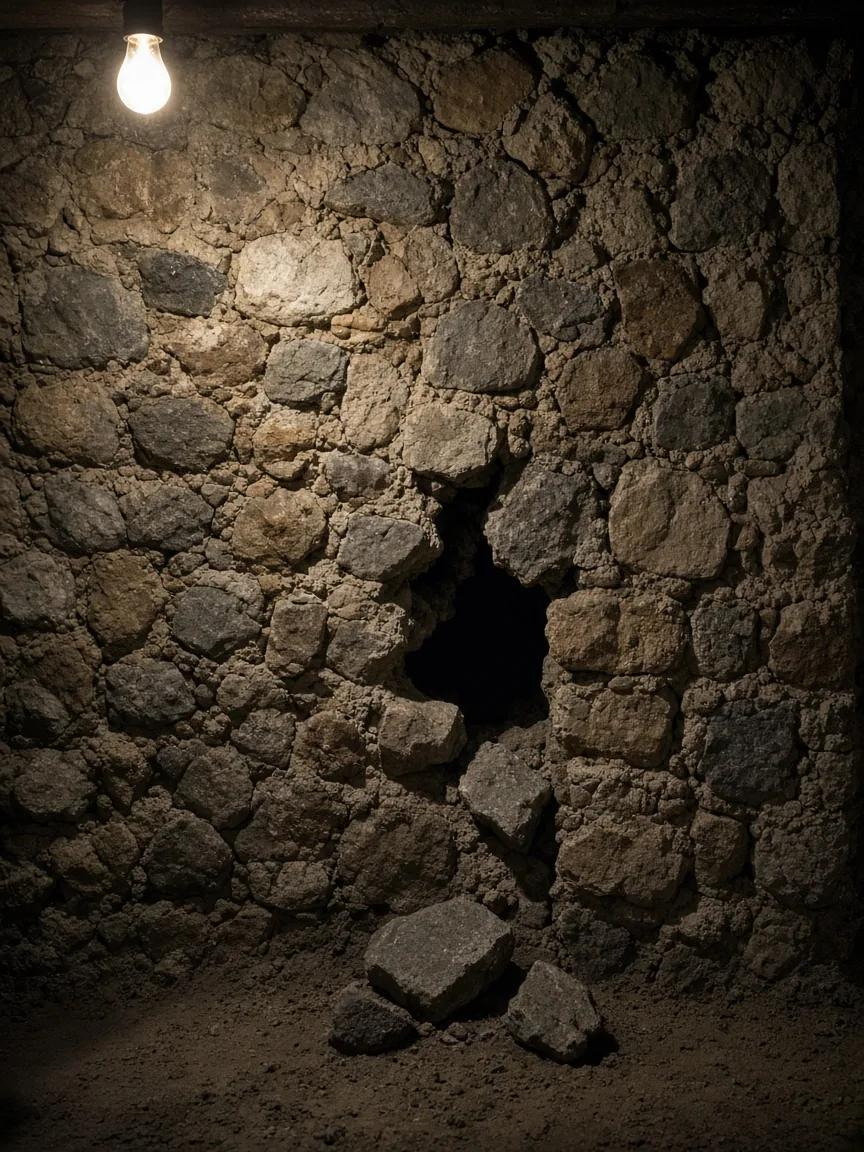
Fieldstone and rubble foundation repair in Kansas City means resetting stones that have loosened or dropped, refilling deep joints with lime mortar, and rebuilding short sections that have lost their bond, without flattening a wall that was never meant to be flat.
A rubble foundation can look rough enough to worry a new owner. Much of that roughness is how the wall was built. The goal of a repair is to keep the stones bonded and the water managed, not to make the wall look like poured concrete.
What a rubble foundation is, and why uneven is not a defect
A rubble wall is built from irregular stone, roughly shaped or not shaped at all, laid in a thick bed of mortar. Small stones and chips fill the gaps between larger ones. The face is uneven, the joints vary from narrow to several inches wide, and no two courses line up. That is normal for this kind of wall.
People use the word "fieldstone" for almost any rough stone foundation, whatever the stone is. The repair logic is the same whatever the stone: keep the pieces bonded, keep the joints full, and keep the water away. For walls built of squared, cut stone, see limestone foundation repair.
Signs a rubble wall needs repair
- Voids you can reach into, where mortar has washed out from between stones.
- Stones you can wiggle or lift out by hand.
- Piles of grit and small stones at the base of the wall.
- A fresh bulge, or a section that looks different from the last time you checked.
- Gaps opening between the top of the wall and the wooden sill.
The U.S. Department of Housing and Urban Development's Residential Rehabilitation Inspection Guide says masonry foundation walls should be inspected for cracking, deterioration, moisture penetration and structural adequacy. Those are the same four things we look at on a rubble wall.
How we repair a rubble wall
Reset and wedge loose stone. Stones that move are taken out, the bed behind them is cleaned, and they are set back in fresh mortar with small stones wedged in to lock them.
Deep-point the joints in layers. Rubble joints are deep. The National Park Service's guidance on repointing, Preservation Brief 2, says old mortar should be removed to about 2 to 2.5 times the joint width and that wide stone joints may need several inches. Deep areas are filled first in thin layers of about a quarter inch, each one stiffening before the next. Filling a deep joint in one heavy pass leaves voids and cracks. Our page on lime mortar repointing covers the full method.
Rebuild a section with the same stone. Where a stretch of wall has lost its bond, we take it down, keep the stone, and relay it in fresh lime mortar. Reusing the original stone keeps the wall consistent and avoids mixing materials that behave differently.
Parge coats on rubble: when a lime coat helps and when cement hurts
A parge coat is a layer of mortar or render over the face of the wall. On a rough stone wall, people often reach for a cement parge to make it look finished and to hide the stone.
The National Park Service's moisture guidance, Preservation Brief 39, warns that waterproof coatings on the inside of a damp wall, including cement parging, can trap moisture and drive rising damp higher. Where a wall needs a sacrificial coat, it recommends a vapor permeable, lime-based render instead. A lime coat lets the wall dry and can be renewed. A cement coat traps the water behind it until it lets go in sheets.
Cement patches from earlier repairs
Some rubble walls carry patches of gray cement from past repairs. Hard cement does not move with the softer stone and lime mortar around it. Preservation Brief 2 explains that a mortar too strong for the masonry pushes stress into the stone, which shows up as cracking and spalling. The patch can stay put while the stone and old mortar around it crumble, or the patch pops off and takes a layer of stone face with it.
Where a cement patch is causing damage, we cut it out carefully with hand tools, which the brief calls the least damaging removal method, and refill the joints with lime mortar.
When a rubble wall is past masonry repair
If a section of wall is leaning or bellying, or stones are being pushed out of line rather than just falling out, masonry repair alone will not hold. Read our page on bowing limestone walls for how we decide between repointing, rebuilding and bracing. If the wall is wet, also see moisture in stone foundations. For what moves the price, see stone foundation repair cost.
Fieldstone and rubble questions
How long do fieldstone foundations last?
We have no reliable figure for the life of a stone wall itself, and we will not invent one. What is documented is the life of the mortar: Preservation Brief 2 says a good repointing job should last at least 30 years and preferably 50 to 100 years. A rubble wall outlasts its mortar when the joints are kept up and the water is managed.
Should a rough stone wall be smoothed over with concrete?
No. A cement coat can trap moisture in the wall, as Preservation Brief 39 explains, and it hides the joints you need to see to keep the wall healthy. If the wall needs a coat, a breathable lime render is the better choice.
Can you waterproof a fieldstone wall?
Not by sealing it shut. A stone wall stays healthy by letting moisture out. The fix is to keep water away from the outside and let the wall dry. Our page on moisture in stone foundations explains the order of work.
How to repair an old stone foundation wall?
Fix the water first, then rake out and refill the failed joints with a lime mortar softer than the stone, and reset or rebuild any stone that has loosened. If any part of the wall is moving, decide how to stabilize it before the masonry work.
Sources
- U.S. Department of Housing and Urban Development, Residential Rehabilitation Inspection Guide (2000)
- National Park Service, Preservation Brief 2: Repointing Mortar Joints in Historic Masonry Buildings (1998)
- National Park Service, Preservation Brief 39: Controlling Unwanted Moisture in Historic Buildings (1996)
Get a rubble foundation repair quote
Send photos of the loose stones, the deepest joints and any bulge, plus the outside on that side of the house. Ask for a rubble foundation repair quote.