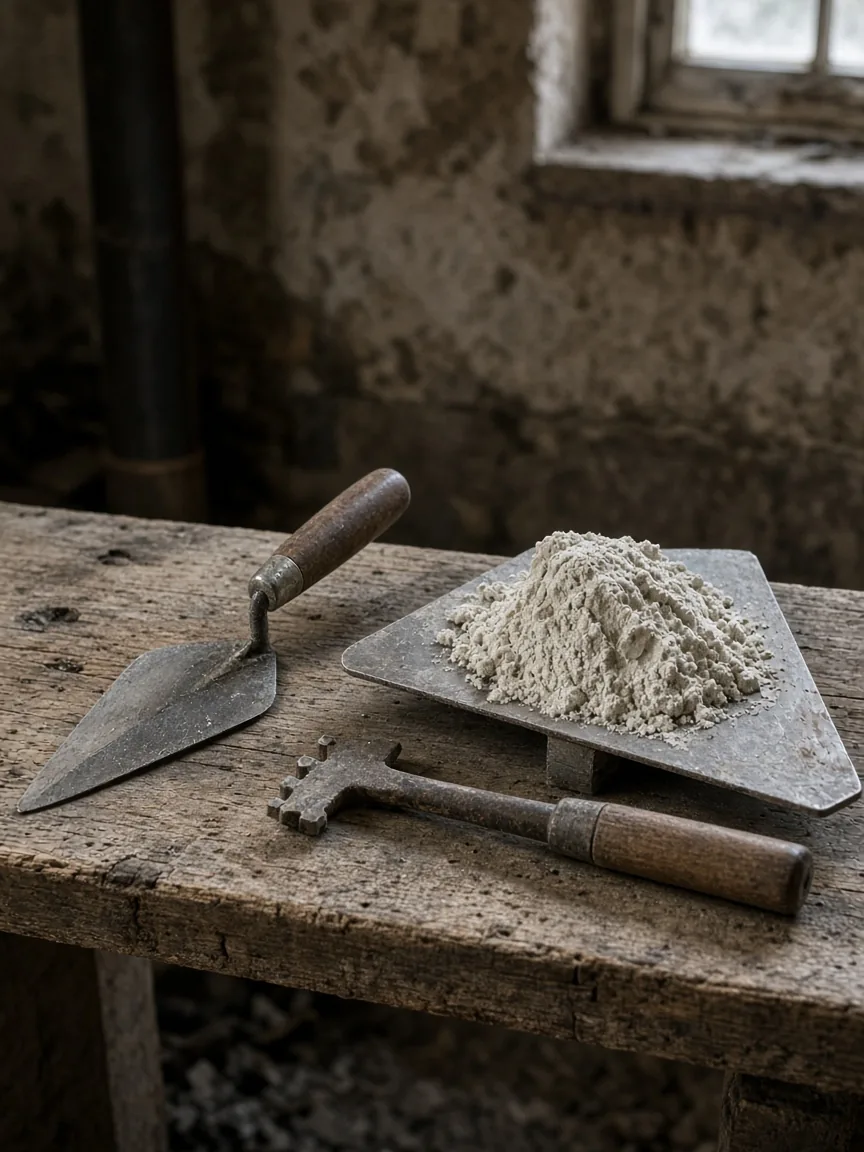
On older Kansas City stone foundations, repointing with a hard Portland cement mix can trap moisture and push stress into the stone, which is why a softer lime-based mortar matched to the original is the standard repointing choice.
This guide draws on the National Park Service's Preservation Brief 2: Repointing Mortar Joints in Historic Masonry Buildings, the standard reference for repointing old masonry.
The short answer
Use a mortar that is softer and more breathable than the stone, and no harder than what was in the wall originally. For an old stone foundation, that almost always points to lime-based mortar. Portland cement mortar is strong and useful in modern construction, but on old stone the strength works against the wall.
What lime mortar is and how it cures
Lime mortar is made from lime, sand and water. Unlike cement, which sets by a chemical reaction with water, lime mortar hardens by absorbing carbon dioxide from the air, as Preservation Brief 2 explains. That is why it cures slowly, why it needs to be kept damp while it cures, and why it stays somewhat soft and porous once it has.
Those properties are the point. A soft, porous joint lets moisture escape through the mortar rather than the stone, and gives a little as the wall moves with the seasons.
When Portland cement arrived, and what that says about your house
Preservation Brief 2 gives the history. Portland cement was patented in Britain in 1824 and first manufactured in the United States in 1872. It was not in common use until the early 20th century. By the 1930s, mortar of equal parts portland cement and lime putty was common. The brief says mortar in buildings from about 1873 to 1930 can range from pure lime to many lime and cement combinations.
That range matters in Kansas City. The National Register nomination for the Old Hyde Park West Historic District in Midtown says most of its buildings date from 1900 to 1909, squarely inside that window. A house from those years could have a lime mortar, a lime and cement blend, or a mix of both from later repairs. The only way to know is to look at a sample.
What hard mortar does to softer stone
Preservation Brief 2 is direct about this. It says hardness is not the measure of a suitable mortar. A mortar that is too strong pushes stress into the masonry units, which shows up as cracking and spalling, and a mortar that is less permeable traps moisture in the units.
In a stone foundation, that looks like stone faces flaking off around hard gray patches, while the patches themselves stay sound. The wall has been forced to sacrifice its stone instead of its joints. Stone is far harder to replace than mortar.
How to tell what is in your wall now
A few signs help:
- Color. Lime mortar tends toward a softer, warmer tone, shaped largely by its sand. Cement mortar tends to be a flatter gray.
- Hardness. Lime mortar can often be scratched with a key or screwdriver. Hard cement mortar resists.
- Weathering. Lime joints erode gradually and evenly. Hard cement patches tend to stand proud of eroded stone around them, or crack and pop out in pieces.
Preservation Brief 2 recommends comparing samples of unweathered original mortar, taken from deep in a joint, rather than judging the weathered surface. A sample tells more than a glance.
Mortar strengths, from M down to K
Preservation Brief 2 lists mortar types from strongest to weakest as M, S, N, O and K, at approximately 2,500, 1,800, 750, 350 and 75 psi. The brief classes limestone as a moderately durable stone.
That chart does not choose the mortar for you. The right choice for a given wall is made from the original mortar and the condition of the stone, not by reading down a table. What the chart does show is how wide the range is, and how far the strongest mixes sit above the softest.
Taking old cement patches out without wrecking the stone
Removing hard cement from soft stone is delicate. Preservation Brief 2 calls hand chisels the traditional and least damaging method, and warns that power saws and grinders can damage masonry edges in unskilled hands. Damaged edges make wider joints and a wall that never looks right again. Slow hand work is the price of keeping the stone.
For how we put this into practice, see our pages on lime mortar repointing, limestone foundation repair and historic stone foundations. If you are buying an older house, our guide on buying a house with a stone foundation covers what to look for. More guides are listed on our guides page.
Lime mortar questions
When should lime mortar not be used?
Outside its temperature window: Preservation Brief 2 says repointing should be done when wall temperatures are between about 40 and 95 degrees Fahrenheit. It is also not the match where the original mortar and masonry are hard modern materials, since the new mortar should suit the wall it goes into.
What type of mortar is used on a stone foundation?
One that is softer and more permeable than the stone and no harder than the original, per Preservation Brief 2. On old stone foundations that is normally a lime-based mortar matched to a sample.
Why use lime mortar instead of cement?
Because the joint should be the part that wears and breathes, not the stone. Lime mortar lets moisture out through the joints and gives with the wall's movement. Hard cement mortar makes the stone take the stress and hold the water.
Can you still buy lime mortar?
Yes. Lime and lime mortars are made and sold today for restoration work.
Sources
- National Park Service, Preservation Brief 2: Repointing Mortar Joints in Historic Masonry Buildings (1998)
- Missouri State Historic Preservation Office, National Register nomination, Old Hyde Park West Historic District (2003)
Get your wall's mortar looked at
Send close photos of the joints, including any gray cement patches. Ask for a repointing quote.