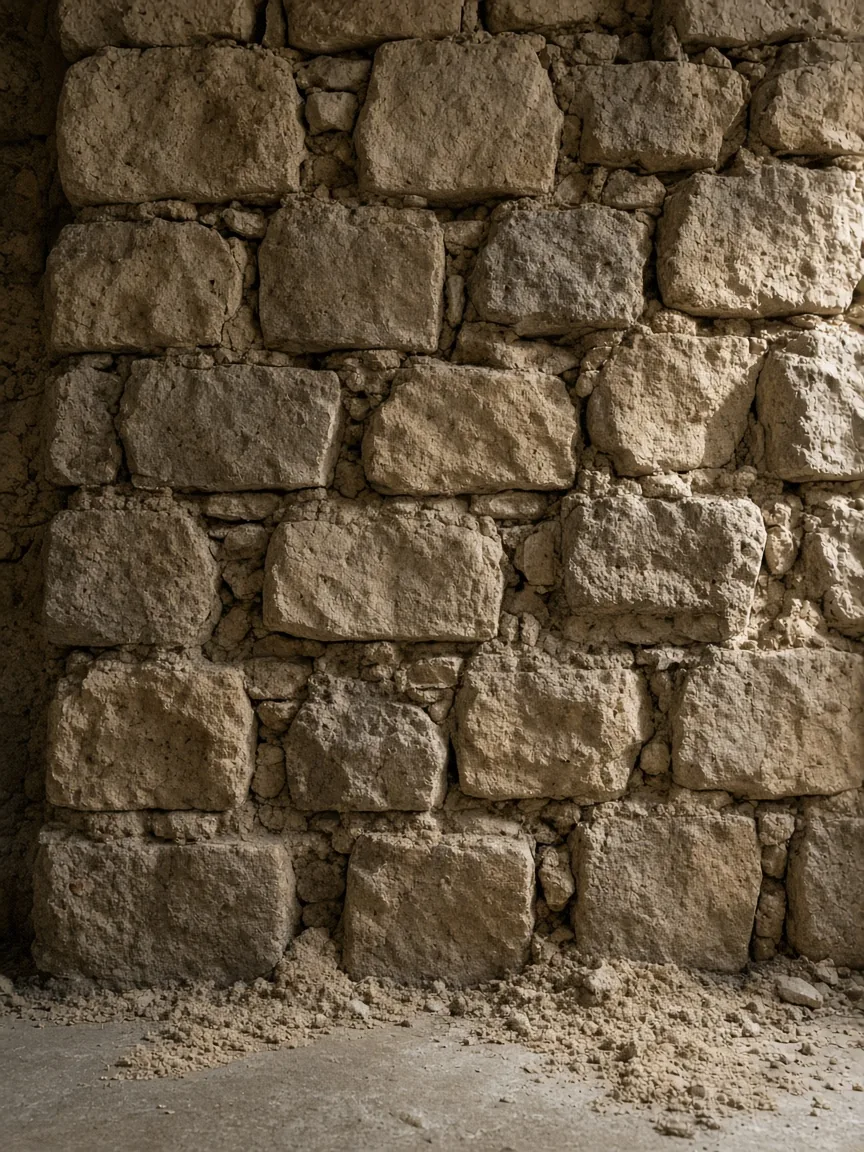
Lime mortar repointing in Kansas City means raking failed joints out of a stone or brick foundation and refilling them with a lime-based mortar that is softer and more breathable than the stone, the job most people here call tuckpointing.
Repointing is the repair a stone foundation needs again and again over its life, and it is easy to do badly. The method we follow comes from the National Park Service's guidance on repointing historic masonry, Preservation Brief 2, which is the standard reference for this work.
Repointing and tuckpointing: what each word means on a foundation
Strictly speaking, repointing is the process of removing deteriorated mortar from joints and filling them with new mortar. Tuckpointing originally named a decorative finish, where a thin line of contrasting mortar was set into a flush joint to make the brickwork look finer.
On a foundation in Kansas City, people use the two words for the same job: taking out the old, failed mortar and putting new mortar in. If you asked for foundation tuckpointing, this is the page you want. What matters is not the name but the mortar and the method.
Signs the joints need repointing
- Sand or grit collecting at the base of the wall.
- Joints recessed behind the face of the stone, sometimes deep enough to fit a finger in.
- Small stones or chinking pieces that are loose or have fallen out.
- Daylight, drafts or insects coming through the wall near the sill.
- Damp patches that follow the joint lines rather than the stone.
None of these is an emergency by itself. Together they mean the wall is losing the part that holds the stones in place and keeps water out.
Why the new mortar must be softer than the stone
Preservation Brief 2 says new mortar should be softer than the masonry units and more vapor permeable than them, and no harder or less permeable than the historic mortar. It also says plainly that hardness is not the measure of a suitable mortar.
When the mortar is the weaker partner, movement and moisture work their way out through the joints. When the mortar is harder than the stone, the stone has to absorb the stress and hold the moisture, and the brief describes the result as cracking and spalling. That is why a quick patch with a strong cement mix often leaves the wall worse off a few years later. Our guide on lime mortar vs Portland cement explains the history and the chemistry.
How we repoint a stone foundation, step by step
- Rake out the failed mortar. Preservation Brief 2 says to remove old mortar to a depth of about 2 to 2.5 times the joint width, and notes that wide stone joints may need several inches. We start with hand chisels, which the brief calls the traditional and least damaging method. Power tools in unskilled hands can chip the edges of the stone.
- Clean and dampen the joints. Dust comes out, and the joints are dampened before filling so the dry stone does not pull water out of the fresh mortar too fast. The brief notes that absorbent stone like limestone may need misting.
- Fill the deep areas first. Deep joints are filled in thin layers of about a quarter inch, and each layer is allowed to stiffen to thumbprint hardness before the next goes in.
- Tool the joint. The final layer is shaped to match the original joint profile.
- Keep it damp while it cures. Lime-rich mortar is kept damp by misting and covering for about three days so it cures instead of drying out.
Matching the mortar already in your wall
A repointed wall should look like the same wall. Preservation Brief 2 says matching starts with a sample of unweathered original mortar, taken from deep in a joint, and that the sand drives most of the color and texture. We build a small test panel so you can see the new mortar beside the old before the full job goes ahead. For walls of cut limestone, our page on limestone foundation repair covers stone replacement as well.
Weather limits for lime mortar work
Lime mortar is sensitive to temperature while it cures. Preservation Brief 2 says repointing should be done when wall temperatures are between about 40 and 95 degrees Fahrenheit. Exterior faces are limited by the season. Basement interior walls stay within range for more of the year, so interior repointing can often go ahead when outside work has to wait.
What repointing will not fix
Repointing replaces worn joints. It does not cure the cause of the wear. Preservation Brief 2 says repointing should follow a diagnosis, and that leaking roofs or gutters, differential settlement and rising damp should be corrected first, or the new mortar keeps failing.
- If water is soaking the wall, read about moisture in stone foundations first.
- If the wall is leaning or bellying, read about bowing limestone walls. New mortar will crack in a wall that is still moving.
- If stones are loose or missing in a rough wall, see fieldstone and rubble repair.
How long a repointing job should last
Preservation Brief 2 says a good repointing job should last at least 30 years and preferably 50 to 100 years. Getting there depends on three things: the right mortar, careful joint preparation, and a wall that is no longer being soaked. For what moves the price, see stone foundation repair cost.
Repointing questions
What type of mortar is best for repointing a stone foundation?
One that is softer and more vapor permeable than the stone, and no harder than the original mortar in the wall, per Preservation Brief 2. For old stone foundations that normally means a lime-based mortar matched to a sample of the original.
What are the disadvantages of lime mortar?
It cures more slowly than cement mortar, it has a narrower weather window, it needs the joints dampened and the new work kept damp while it cures, and it needs a mason who knows how to handle it. Those are reasons to do it properly, not reasons to use something harder.
Is lime pointing difficult?
It takes skill. Preservation Brief 2 suggests that specifications for historic repointing call for masons with at least five years of experience repointing historic masonry, and a test panel before the full job. Those are fair things to ask any contractor about.
Can I use bagged mortar mix from a hardware store?
Common bagged mortar mixes are portland cement based and hard. On an old stone foundation, that is the kind of mortar Preservation Brief 2 warns against, because it can push stress into the stone and trap moisture. A small emergency patch is better than an open hole, but it is not a repointing job.
Sources
- National Park Service, Preservation Brief 2: Repointing Mortar Joints in Historic Masonry Buildings (1998)
- National Park Service, Preservation Brief 39: Controlling Unwanted Moisture in Historic Buildings (1996)
Get a repointing quote
Send a wide photo of the wall, close photos of the worst joints, and a photo of the downspouts on that side. Ask for a repointing quote.