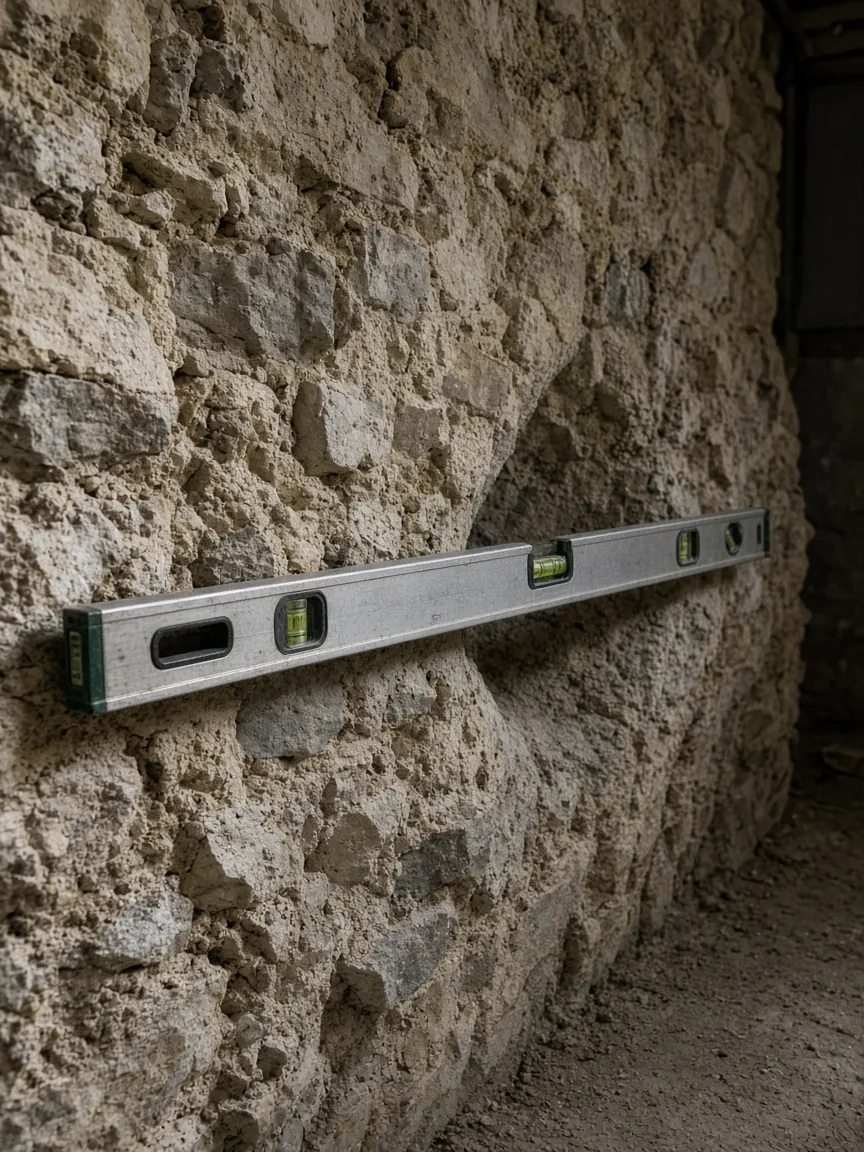
A bowing limestone basement wall in Kansas City needs two things: the water and clay pressure behind it relieved, and the wall itself rebuilt, reset or braced, because new mortar alone will not hold a stone wall that is still moving.
A leaning or bellied stone wall looks alarming, and sometimes it is. Other times it moved decades ago and has been stable since. The repair depends on which of those is true, so the first job is finding out.
How a stone wall bows
A mortared stone wall is many separate pieces held in place by their own weight, their bond with each other, and the mortar between them. When pressure from the soil outside is greater than the wall can resist, the wall does not crack in a clean line the way a block wall does. Instead it tends to belly inward over an area, or lean as a whole, with stones rotating and joints opening on the inside face.
You may see a soft curve in the wall when you sight along it, stones whose faces no longer line up, joints that are wide on the inside and tight on the outside, or a gap opening between the top of the wall and the wooden sill above it.
What pushes on the wall
Clay soil. K-State Research and Extension in Johnson County describes local soils as very high in clay. Clay swells when it is wet and shrinks when it dries, and in dry weather cracks can open to an inch or more. When rain fills those cracks and the clay swells again, it presses on whatever is beside it, including your foundation.
Roof water. The National Park Service's moisture guidance, Preservation Brief 39, notes that a rain of 2 inches in an hour can send about 200 gallons through one downspout in that hour. If that water is dumped beside the wall, the soil against that section stays saturated and heavy. So when we look at a bowed section, we check what is directly above it outside: a downspout, a low spot in the grade, or a walk that sheds water toward the wall.
Lost mortar. A wall with empty joints has less to hold its stones together, so it resists pressure poorly. Joint loss does not make a wall bow by itself, but it makes a wall easier to push.
Measure first: is the wall still moving?
This is the question that decides the repair. We record the wall's shape with a plumb line or straightedge, mark and date reference points, and photograph them. Then we look again after wet weather and dry weather.
Preservation Brief 39 notes that diagnosing moisture problems can take months, up to four seasons. Wall movement in clay soil follows the same seasons, so a single visit in a dry month can miss what happens in a wet one. If the wall shows fresh signs of movement, we treat it as active.
Repair options, from least to most work
- Relieve the water and repoint. A shallow belly that has stayed put, with stones still bonded, can often be stabilized by fixing the roof water and grade on that side and then repointing the joints with lime mortar.
- Take down and rebuild a section. Where a short run of wall has bellied and lost its bond, we take it down stone by stone, keep the original stone, and relay it plumb in fresh mortar. This is ordinary masonry work on a stone wall and is often the most durable fix.
- Brace a wall that is still moving. A wall that is still moving needs restraint before or alongside the masonry repair.
- Replace a section that has lost its bond. Where stone has broken up or the wall can no longer be relaid as it was, that section is rebuilt with stone matched to the rest.
For rough rubble walls, see fieldstone and rubble foundation repair, which covers resetting and deep-pointing in detail.
Why we do not sell straps or anchors as a stone wall cure
Restraint for a moving stone wall is a structural decision about that wall, not a product to install by the foot. Our approach is to decide first whether the wall is moving and why, then choose the restraint if it needs one, and then make the masonry repair that keeps the stone bonded. Selling a product before answering those questions is how walls end up braced and still crumbling.
Signs a bowing stone wall needs attention now
- A stone that has shifted out of line or dropped since you last looked.
- A new or widening gap between the top of the wall and the sill.
- Fresh piles of mortar debris after a rain.
- Doors or windows above that wall suddenly starting to stick.
- Water coming through a section that used to be dry.
If you see these, take dated photos and ask for a look. Also read our page on moisture in stone foundations, because the water on that side is a likely part of the cause.
Who does which part of the job
Masonry repair, resetting and rebuilding are done by our licensed crew. If a wall needs an engineered design for bracing, we will say so plainly, and that design is arranged separately before the bracing goes in. We do not write engineer reports. If you are buying a house with a leaning stone wall, our guide on buying a house with a stone foundation explains how to handle it before closing. For what drives the price, see stone foundation repair cost.
Bowing stone wall questions
How much bowing is acceptable in a stone basement wall?
There is no single number that applies to every stone wall, and we will not give you one. What matters most is whether the bow is changing. A wall that bellied long ago and has not moved since is a very different case from one that moved last spring, which is why we measure over time.
Can a bowing stone wall be fixed without rebuilding it?
Sometimes. If the wall is stable, the stones are still bonded, and the water on that side can be fixed, repointing may be enough. If stones have rotated out of line or the bond is gone, rebuilding that section is usually the lasting fix.
Will repointing stop a wall from bowing?
No. The National Park Service's guidance on repointing, Preservation Brief 2, says causes such as differential settlement and water problems should be corrected before repointing. New mortar in a wall that is still being pushed will crack again.
What causes a basement wall to bow?
Pressure from outside that is greater than the wall can resist. Around Kansas City the pressure comes from clay soil that swells when wet, made worse by roof water dumped beside the foundation, as described by K-State Research and Extension and Preservation Brief 39.
Sources
- K-State Research and Extension, Johnson County, Clay Soil: It shrinks and swells
- National Park Service, Preservation Brief 39: Controlling Unwanted Moisture in Historic Buildings (1996)
- National Park Service, Preservation Brief 2: Repointing Mortar Joints in Historic Masonry Buildings (1998)
Get a bowing stone wall assessed
Send a photo of the wall with a straightedge or string held against it, and a photo of the outside on that side. Ask for a bowing stone wall quote.